Introduction
Leveling up your career while working remotely? You’ve probably already faced the big question: enroll in a traditional college program, or learn from the comfort of your home office? As remote work reshapes how we think about professional development, this debate has never felt more relevant. The great news is that, as [2] points out, neither online nor traditional learning is inherently “better” — it really comes down to your learning style, career goals, and available resources. Whether you’re building skills for a distributed team, upgrading your async work habits, or simply chasing a promotion, this guide breaks down everything you need to make the smartest choice for your future.
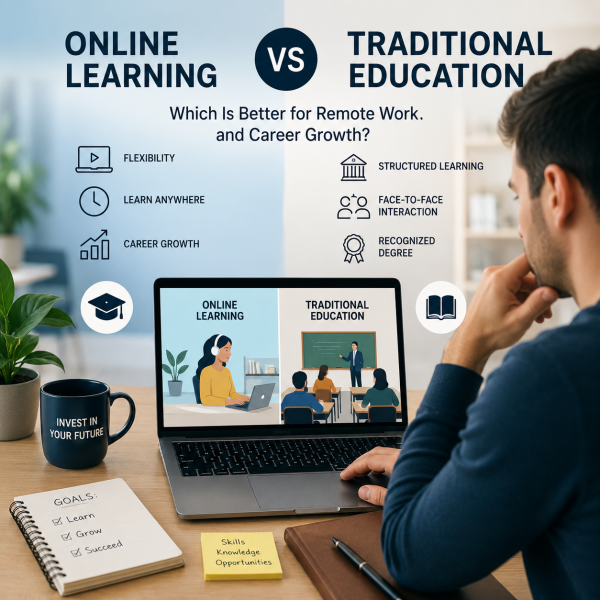
Quick Comparison Table
| Feature | Online Learning | Traditional Education |
|---|---|---|
| Flexibility | ✅ High (async, self-paced) | ❌ Fixed schedules |
| Cost | ✅ Generally lower | ❌ Often more expensive |
| Networking | ⚠️ Limited but possible | ✅ Strong in-person connections |
| Accreditation | ⚠️ Varies by platform | ✅ Widely recognized |
| Certificates | ✅ Fast to earn | ✅ Degrees carry prestige |
| Home-office friendly | ✅ Yes | ❌ Requires commute |
| Hands-on experience | ⚠️ Depends on course | ✅ Labs, clinics, studios |
Platform A Overview
Online Learning
Online education has exploded in popularity — and honestly, it’s easy to see why. Platforms like Udemy, edX, and LinkedIn Learning let you study at midnight in your pajamas or squeeze in a lesson during your lunch break. The biggest win? Flexibility. As [1] highlights, virtual education offers a more flexible schedule, lower costs, and an easier path to career development. For remote workers juggling async work, distributed teams, and home office setups, that kind of adaptability is pure gold. You can upskill without hitting pause on your career — and in today’s fast-moving job market, that’s a massive advantage.
Platform B Overview
Traditional Education
Traditional education isn’t going anywhere — and it shouldn’t. There’s something genuinely powerful about sitting in a room with a professor and fellow students, bouncing ideas off each other in real time. As [3] reminds us, even as online education grows, traditional classroom learning still delivers powerful advantages — especially for students who thrive on structure, in-person mentorship, and hands-on experiences. Think medical labs, design studios, or engineering workshops: some skills simply click better when you’re physically present. Add in the campus networking experience — study groups, clubs, career fairs — and you get doors that no algorithm can replicate.
Pricing
Let’s talk money — because it matters a lot. Traditional four-year degree programs can run anywhere from $20,000 to over $100,000 depending on the institution. Online learning, by contrast, ranges from completely free (hello, audit options on edX and Coursera) to a few hundred dollars for a professional certificate. [4] notes that online and blended learning deliver unmatched benefits, and cost savings sit near the top of that list. For remote workers and career-changers who need to upskill without drowning in debt, online platforms offer incredible value. That said, some employer-sponsored traditional programs can offset tuition costs significantly — always check what’s on the table before you commit!
→ Browse courses on Skillshare
Certificates
Credentials can make or break a job application, so it pays to understand what you’re earning. Traditional degrees from accredited universities still carry serious weight with many employers — particularly in law, medicine, and engineering. But online certificates are rapidly gaining credibility, especially in tech, marketing, data science, and creative industries. LinkedIn Learning certificates, for instance, land directly on your LinkedIn profile, making them instantly visible to recruiters. University-backed online programs through platforms like edX (think MIT or Harvard courses) blur the line even further. The key move? Research what your target industry actually values before you invest your time and money.
→ Browse courses on LinkedIn Learning
Pros & Cons
Online Learning
Pros: Flexible scheduling, lower cost, self-paced, perfect for remote workers, wide variety of topics, fast certificate completion. Cons: Demands strong self-discipline, limited in-person networking, some employers still favor traditional degrees, quality varies by platform.
Traditional Education
Pros: Structured learning environment, strong networking opportunities, widely recognized degrees, hands-on experiences, full access to campus resources. Cons: Expensive, rigid scheduling, requires commuting, and curriculum updates slowly compared to fast-moving industries.
Which One Should You Choose?
Here’s the honest answer: it depends on you. If you’re a remote worker building skills while holding down a job, online learning is a no-brainer for agility and affordability [1][4]. If your target field requires accredited credentials — or you simply learn best face-to-face — traditional education is likely worth the investment [3]. Many savvy career-builders are choosing both: earning a traditional degree while stacking online certificates to stay current. The modern career path is rarely linear, and your education strategy doesn’t have to be either [2].
→ Browse courses on FutureLearn
FAQ
Q: Are online degrees respected by employers? A: Increasingly, yes — especially from accredited institutions or recognized platforms. Industry-specific certifications from Google, IBM, or LinkedIn Learning are widely accepted in tech and business roles.
Q: Can I network effectively through online learning? A: Absolutely! Many platforms offer discussion forums, live sessions, peer projects, and alumni communities. It takes more intentional effort than campus life, but it’s very doable.
Q: How do I stay motivated studying online from home? A: Set a dedicated study schedule, carve out a distraction-free home office corner, lean on productivity tools like Notion or Todoist, and join online study groups for accountability.
Q: Is online learning suitable for all careers? A: Most careers benefit from online learning, but fields requiring hands-on clinical or lab work — medicine, dentistry, certain engineering disciplines — still depend heavily on in-person training.
Q: What’s the fastest way to upskill for a remote job? A: Short online courses and micro-credentials in high-demand skills like data analysis, project management, and digital marketing are your fastest ticket to remote job readiness.
Recommended reading:
How to Get a Remote Job With No Experience: A Beginner’s Home Office Guide
Best Remote Jobs in 2026: Top Work-From-Home Careers and Tools
Remote Work vs Office Work: Which Setup Works Best for Your Career?
Sources
- https://drexel.edu/soe/resources/student-teaching/advice/benefits-of-online-and-virtual-learning/
- https://www.sophia.org/blog/higher-education/pros-cons-online-learning-vs-traditional-education/
- https://ace.edu/blog/examining-in-person-instruction-from-a-virtual-mindset-what-can-we-improve/
- https://extension.harvard.edu/blog/going-the-distance-why-online-learning-works/