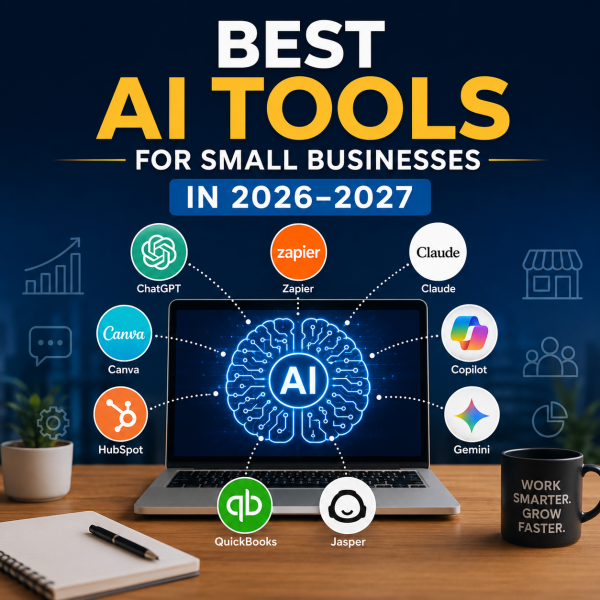
Artificial intelligence is no longer just a technology for large corporations. In 2026, small businesses across the United States can use AI to automate repetitive work, create marketing content, improve customer service, analyze information, and make better business decisions—often without hiring a dedicated technical team.
The challenge is choosing the right tools. There are thousands of AI products available, but most small businesses do not need dozens of subscriptions. A practical AI stack usually combines a general-purpose assistant with a few specialized tools for marketing, automation, customer management, and productivity. Recent 2026 comparisons consistently highlight tools such as ChatGPT, Canva, HubSpot, Zapier, and other workflow-focused platforms for small-business use.
Here are some of the best AI tools for small businesses in 2026–2027, organized around the tasks that matter most.
1. ChatGPT — Best Overall AI Tool
ChatGPT is one of the most versatile AI tools available to small-business owners. It can help with writing emails, creating marketing copy, brainstorming products, analyzing documents, preparing business plans, researching topics, creating social media content, and developing customer-service responses.
For a solo entrepreneur or small team, its biggest advantage is flexibility. Instead of purchasing a separate AI application for every simple task, you can use one assistant across multiple areas of the business.
Best for: Writing, research, brainstorming, customer communication, planning, and general productivity.
Why small businesses should consider it: It is easy to start with and can be useful across almost every department.
2. Canva AI — Best for Marketing Design
Small businesses constantly need visual content: social media graphics, advertisements, presentations, product images, flyers, and promotional materials.
Canva’s AI-powered tools make it easier to produce these assets without employing a professional designer for every project. It can help generate designs, edit images, create marketing materials, and adapt content for different platforms.
For local businesses, ecommerce stores, consultants, and creators, Canva can significantly simplify day-to-day content production.
Best for: Social media graphics, advertisements, presentations, product marketing, and branded content.
3. HubSpot AI — Best for CRM and Sales
Customer relationship management can become complicated as a small company grows. HubSpot combines CRM functionality with AI features that can assist with marketing, sales, customer interactions, and lead management.
AI can help businesses organize customer information, create content, support sales workflows, and automate parts of the customer journey. This makes HubSpot particularly interesting for companies that are moving beyond spreadsheets and basic email lists.
Best for: CRM, lead generation, sales, marketing automation, and customer management.
Tip: Start with the workflows that solve an existing problem rather than activating every available AI feature at once.
4. Zapier — Best for AI Automation
One of the biggest advantages of AI for small businesses is automation. Zapier connects different applications and allows businesses to create automated workflows.
For example, a new lead from a website form could be added to a CRM, assigned to a salesperson, recorded in a spreadsheet, and followed by an automated email. AI can be added to certain workflows to classify information, generate text, or make decisions based on predefined rules.
Zapier is especially valuable for lean teams that use many SaaS applications. 2026 small-business tool comparisons consistently identify automation as one of the strongest practical AI use cases.
Best for: Workflow automation, lead management, repetitive administrative tasks, and connecting business applications.
5. Claude — Best for Long Documents and Analysis
Claude is another powerful general-purpose AI assistant and can be particularly useful when a business needs to work with long documents, proposals, reports, policies, or detailed research.
Consultants, agencies, professional-service businesses, and teams that regularly analyze large amounts of text may find this type of AI especially useful.
Best for: Long-form writing, document analysis, research, proposals, and business strategy.
6. Microsoft Copilot — Best for Microsoft 365 Businesses
Businesses that already rely heavily on Microsoft Word, Excel, Outlook, Teams, and other Microsoft products should consider Microsoft Copilot.
The advantage is integration. Instead of constantly moving information between separate AI applications, businesses can use AI within familiar productivity workflows.
Best for: Microsoft 365 users, emails, documents, spreadsheets, presentations, and workplace productivity.
7. Google Gemini — Best for Google Workspace Users
For companies built around Gmail, Google Docs, Sheets, Drive, and Meet, Google’s AI ecosystem can be a natural choice.
Gemini can assist with writing, summarizing information, generating ideas, and working with content inside Google’s productivity environment.
Best for: Google Workspace businesses, email, documents, spreadsheets, research, and collaboration.
8. QuickBooks AI — Best for Small-Business Finance
Accounting is another area where AI can reduce administrative work. QuickBooks offers AI-powered features designed to assist with tasks such as bookkeeping, invoicing, and financial organization.
However, AI should not replace professional accounting judgment. Business owners should review important financial information and consult a qualified professional when necessary.
Best for: Bookkeeping assistance, invoices, financial organization, and routine accounting tasks.
9. Jasper — Best for Marketing Content
Businesses that publish a large amount of marketing content may benefit from Jasper. It is designed specifically around marketing and content workflows.
It can help teams produce advertising copy, campaign content, blog drafts, social media material, and other marketing assets while maintaining a consistent brand voice.
Best for: Marketing teams, content marketing, advertising, ecommerce, and brand campaigns.
10. Perplexity — Best for AI-Assisted Research
Small-business owners frequently need to research competitors, markets, products, customers, and industry trends. Perplexity is designed around AI-assisted search and research, making it useful when you need to investigate a topic quickly.
As with any AI research tool, important facts should be checked against original sources before being used in financial, legal, medical, or other high-stakes decisions.
Best for: Market research, competitor research, fact-finding, and business research.
How to Choose the Right AI Tools for Your Business
The best AI stack is not necessarily the one with the most tools. A small business should start by identifying its biggest bottleneck.
If your team spends too much time writing, start with ChatGPT or Claude. If creating visual content is the problem, consider Canva. If leads and customer management are becoming difficult, look at HubSpot. For repetitive tasks between multiple applications, Zapier can be a strong choice.
A practical approach is to start with one general AI assistant and add specialized tools only when they solve a measurable problem. Several 2026 small-business guides recommend exactly this approach rather than building an unnecessarily large AI stack.
Learn AI Skills for Business
Buying AI software is only part of the equation. Employees and business owners also need to understand how to use AI effectively.
For practical, affordable training, consider Udemy’s AI and business courses. Its marketplace includes courses covering generative AI, ChatGPT, automation, marketing, productivity, and other business applications.
Recommended: Learn AI skills on Udemy
For learners who prefer university-backed and professional education, edX offers AI courses and programs from institutions and industry organizations. Its current AI-for-business selection includes programs covering AI fundamentals, leadership, analytics, generative AI, and business applications.
Recommended: Explore AI for Business courses on edX
Final Thoughts
AI can give small businesses access to capabilities that previously required larger teams and bigger budgets. The most valuable tools are not necessarily the most advanced—they are the ones that remove repetitive work, improve productivity, and help employees focus on higher-value activities.
For 2026–2027, a strong starting combination is ChatGPT for general work, Canva for visual marketing, HubSpot for customer management, and Zapier for automation. From there, businesses can add specialized tools as their needs grow.
The goal should not be to use AI everywhere. The goal is to use it where it creates a clear business advantage.
Editor’s Note: This article contains affiliate links. If you purchase a course through one of the links, we may earn a commission at no additional cost to you.
Also worth reading:
AI for Small Business in 2026: Is It Worth the Investment?
AI Automation for Small Businesses: Best Tools, Use Cases & Skills