Introduction
Thinking about a career in data analytics — or already in one and wondering if you’re being paid what you’re worth? You’re not alone. Data analysts are in high demand in 2026, and salaries vary wildly depending on where you live, which tools you know (SQL, Python, Tableau, Power BI), and whether you’ve got cloud platform experience on AWS, Azure, or GCP. Whether you’re just starting out or eyeing that senior analyst title, this guide breaks it all down in plain English — so you can walk into your next salary conversation with real numbers and a clear plan. Let’s dig in.
If you’re still exploring the field, it’s worth understanding exactly what the role involves before chasing the paycheck.
→ How to become a data analyst
Average Salary Overview
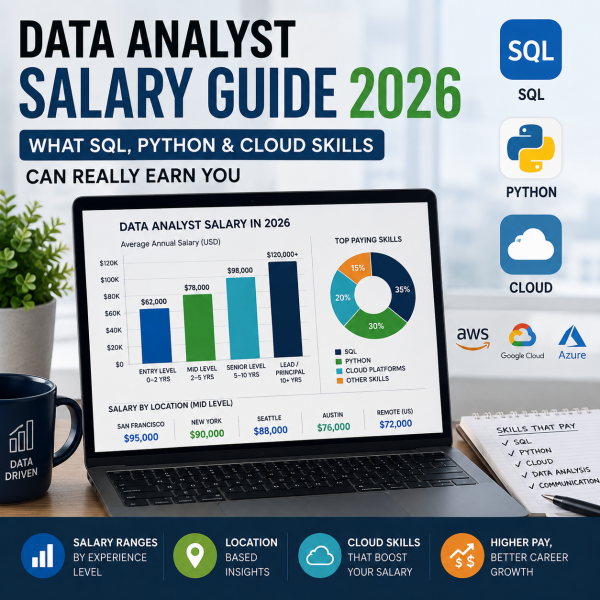
So, what does a data analyst actually make? According to PayScale, the average data analyst salary in the US sits at $70,643 in 2026, with total compensation ranging from $48,000 to $97,000 when bonuses and benefits are factored in [1]. Coursera’s data puts the broader range between $71,000 and $119,000 annually across all experience levels [2]. That’s a wide band — and it’s exactly why understanding the variables matters so much.
If you want to fast-track your entry into this field, a recognized credential can make a real difference.
Salary by Experience Level
Entry-Level (0–2 Years)
Just breaking in? Expect a starting salary somewhere between $50,000 and $70,000 per year [4]. Real talk: Reddit threads from working analysts confirm that landing that first role can feel tough without hands-on project experience [3]. Build a portfolio with SQL queries and Python scripts — hiring managers notice, and it gives you something concrete to reference in interviews.
Mid-Level (3–5 Years)
With a few years under your belt and tools like Tableau or Power BI on your résumé, you’re looking at the $75,000–$95,000 range. This is also the sweet spot where adding cloud skills starts paying off fast.
Senior-Level (5+ Years)
Senior analysts who own end-to-end data pipelines or cloud analytics projects on AWS or Azure can easily clear $110,000+ annually [4]. Strong leadership skills and the ability to connect data insights to business outcomes push these numbers even higher.
Ready to level up your skills and jump salary brackets faster?
→ Data Analyst: Professional Certificate in Data Analysis
Salary by Location / Country
Location is one of the biggest salary levers available to you. In the US, tech hubs like San Francisco, Seattle, and New York consistently pay above average — analysts in California or Washington state routinely out-earn peers doing identical work in the Midwest. Internationally, the UK sees median base salaries around £45,000 [6], while markets in Canada and Australia are competitive but generally trail top US metros.
Curious which US states offer the biggest data paychecks? This resource maps it out clearly.
→ What are the highest-paying states for data scientists?
Salary by Industry
Not all industries pay data analysts equally. Here’s a quick snapshot of where the money flows:
- Finance & Banking — consistently among the top payers, often $85,000–$110,000
- Technology — strong base pay with equity upside; senior roles frequently exceed $120,000
- Healthcare — growing demand, with mid-range pay around $70,000–$90,000
- Retail & E-commerce — competitive but typically below finance and tech
- Government & Non-profit — stable but generally below-market salaries
Industry shapes your ceiling, but how you market your data skills determines how close you get to it.
→ Online Data Analytics Courses – Training & Certificates
What Affects Your Salary
Beyond location and experience, a few key factors move the needle significantly:
- Technical stack: Analysts fluent in Python, SQL, and cloud platforms (AWS, Azure, GCP) earn meaningfully more than Excel-only analysts
- Business impact: Analysts who connect data insights to revenue decisions — and can tell that story clearly — get paid like it
- Specialization: Skills in machine learning prep, data engineering, or DevOps workflows command real premiums in 2026
- Company size: Big tech firms and Fortune 500 companies almost always out-pay small businesses at every experience level
Investing in the right skills now pays literal dividends later.
→ Data analysis courses online
How to Negotiate
Never accept the first offer without doing your homework. Here’s a simple playbook that works:
1. Research market rates using PayScale, Glassdoor, and LinkedIn Salary before your interview 2. Anchor high — start your ask 10–15% above your target number 3. Quantify your impact — frame past wins in dollars or percentages, not just tasks completed 4. Negotiate the full package — remote flexibility, learning budgets, and equity can make up ground when base salary is fixed 5. Embrace the silence — after stating your number, let the hiring manager respond first
Certifications That Boost Pay
Certifications signal commitment and validate your skills to employers. The ones most consistently linked to higher data analyst salaries in 2026 include:
- Google Data Analytics Professional Certificate — great for career changers and entry-level candidates
- Microsoft Power BI Data Analyst (PL-300) — directly tied to one of the most in-demand BI tools on the market
- AWS Cloud Practitioner / AWS Solutions Architect (SAA) — cloud fluency is increasingly expected in data roles
- Microsoft Azure AZ-900 — a solid cloud foundation cert recognized across industries
- Tableau Desktop Specialist — validates the visualization skills employers actively seek
Cloud certifications are reshaping what it means to be a data analyst in 2026. Analysts who understand cloud data warehouses like AWS Redshift or Google BigQuery have a clear, measurable edge over the competition.
FAQ
Q: Is $70,000 a good starting salary for a data analyst? It’s solid for most US markets outside major tech hubs, where you’d want to aim closer to $80,000+ [1].
Q: What’s the fastest way to increase my data analyst salary? Add cloud skills (AWS, Azure) and master a visualization tool like Tableau or Power BI. These combinations consistently appear in the highest-paying job listings.
Q: Do I need a degree to become a data analyst? Not necessarily. Many employers now prioritize portfolios, certifications, and demonstrated SQL and Python skills over formal degrees [3].
Q: How long does it take to go from entry-level to senior analyst pay? Typically 4–6 years — but analysts who pursue cloud certifications and take on high-visibility projects regularly compress that timeline [4].
Data analytics is one of the most rewarding fields you can enter right now, and your earning potential is more in your control than you might think. Master the right tools, earn the certs that matter, and negotiate with confidence — the salary you want is genuinely within reach.
Also worth reading:
Google Data Analytics Professional Certificate: Honest Review for Aspiring Data Analysts
Sources
- https://www.payscale.com/research/US/Job=Data_Analyst/Salary
- https://www.coursera.org/articles/how-much-do-data-analysts-make-salary-guide
- https://www.reddit.com/r/dataanalysis/comments/16mq949/what_are_realistic_starting_data_analyst_salaries/
- https://online.siue.edu/degrees/undergraduate/bsba/data-analytics-spec/analyst-salary-guide/
- https://www.levels.fyi/t/data-analyst
- https://careercenter.fresnostate.edu/blog/2025/10/27/a-guide-to-entry-level-data-analyst-salary-and-how-to-negotiate/
- https://www.indeed.com/career/data-analyst/salaries
- https://onlinedegrees.sandiego.edu/data-analyst-careers-and-salary/
- https://advance.appily.com/blog/stem-careers/data-analytics-salary-breakdown-entry-level-to-senior-roles