Last updated: August 2026
Large language models are moving from experimentation into production, and companies increasingly need engineers who can customize, evaluate, optimize, and deploy these models. That has created a growing specialization around LLM fine-tuning and post-training.
So, how much could an LLM Fine-Tuning Engineer earn in 2027?
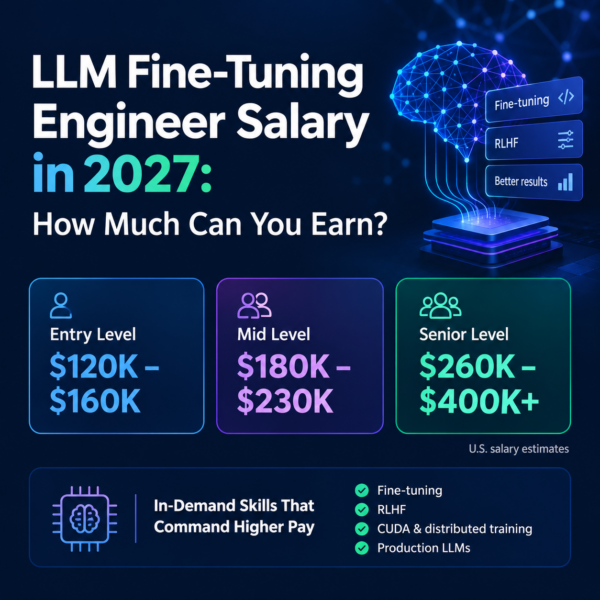
Based on current 2026 compensation benchmarks, specialized AI roles already command substantial salary premiums. For 2027, a reasonable U.S. salary expectation is approximately $140,000–$400,000+, depending heavily on experience, technical depth, location, company, and total compensation.
At leading AI companies and frontier-model labs, experienced engineers can potentially exceed $300,000 in base salary, with equity and bonuses pushing total compensation significantly higher.
2027 Salary Forecast: The figures in this article are projections based on 2026 market data, job postings, and compensation trends. They are not guaranteed 2027 salaries.
Key Takeaways
- Entry-level: approximately $130,000–$180,000
- Mid-level: approximately $180,000–$250,000
- Senior: approximately $250,000–$350,000+
- Staff/Principal: approximately $325,000–$500,000+
- Top AI labs: total compensation can potentially exceed $500,000
The most valuable candidates will combine machine learning fundamentals with hands-on experience in fine-tuning, evaluation, data preparation, GPU infrastructure, and production deployment.
What Is an LLM Fine-Tuning Engineer?
An LLM Fine-Tuning Engineer specializes in adapting existing language models for specific business or technical requirements.
Instead of building a large language model from scratch, these engineers typically start with an existing foundation model and modify its behavior using specialized datasets and post-training techniques.
Common responsibilities include:
- Preparing and cleaning training datasets
- Supervised fine-tuning (SFT)
- LoRA and QLoRA fine-tuning
- Parameter-efficient fine-tuning (PEFT)
- Preference optimization and DPO
- Model evaluation and benchmarking
- Prompt and dataset optimization
- GPU and training infrastructure
- Model quantization
- Inference optimization
- Deploying models into production
The role increasingly overlaps with machine learning engineering, AI infrastructure, and LLM application development.
A current 2026 salary report places LLM Developer median base compensation at $160K for entry-level, $205K for mid-level, $260K for senior, and $325K for staff-level professionals.
LLM Fine-Tuning Engineer Salary in 2027
Entry-Level: $130K–$180K
Breaking into LLM fine-tuning directly at the entry level can be difficult because employers often expect previous machine learning or software engineering experience.
Candidates with a bachelor’s or master’s degree, strong Python skills, PyTorch experience, and a portfolio of fine-tuning projects may compete for junior AI/ML positions.
A realistic 2027 target is approximately:
$130,000–$180,000 base salary
Candidates who can demonstrate practical experience with Hugging Face Transformers, LoRA/QLoRA, evaluation frameworks, and cloud GPUs should have a stronger position than candidates who only have certificates.
Mid-Level: $180K–$250K
Engineers with approximately 2–5 years of relevant experience can move into significantly higher compensation.
At this level, employers expect candidates to understand not only how to fine-tune a model, but when fine-tuning is actually the right solution.
A projected 2027 range is:
$180,000–$250,000 base salary
Experience with production ML pipelines, AWS or Azure, distributed training, model evaluation, and inference optimization can increase earning potential.
Senior: $250K–$350K+
Senior LLM engineers are expected to own complex AI systems from data preparation through deployment.
Their responsibilities may include designing fine-tuning strategies, reducing inference costs, improving model quality, and mentoring other engineers.
A reasonable 2027 projection is:
$250,000–$350,000+ base salary
Current market data already shows senior AI/ML specialists reaching approximately $200K–$310K in base compensation, while specialized LLM roles can command substantially higher packages.
Staff and Principal: $325K–$500K+
At Staff, Principal, or equivalent levels, compensation becomes much more dependent on company and equity.
Engineers working on model training, post-training, infrastructure, or optimization at major AI companies can receive very large total compensation packages.
For 2027, a reasonable projection is:
$325,000–$500,000+ base and total compensation potentially well above $500,000.
For example, a current Principal Machine Learning Engineer role focused specifically on LLM fine-tuning and optimization at Airbnb lists a $292K–$365K annual salary, before considering potential additional compensation.
What Skills Increase an LLM Engineer’s Salary?
Not all LLM skills have the same market value.
1. Python and PyTorch
Python remains fundamental to modern machine learning. PyTorch is particularly important for engineers working directly with model training and fine-tuning.
2. LoRA and QLoRA
Parameter-efficient techniques allow organizations to customize models without the cost of fully retraining billions of parameters.
Understanding LoRA, QLoRA, PEFT, quantization, and memory optimization can make an engineer considerably more useful.
3. Model Evaluation
Companies need engineers who can prove that a fine-tuned model is actually better.
Strong candidates understand:
- Evaluation datasets
- Accuracy and task-specific metrics
- Hallucination testing
- Human evaluation
- Regression testing
- Benchmark design
4. Cloud and GPU Infrastructure
Fine-tuning is not only a machine learning problem. It is also an infrastructure problem.
AWS, Azure, Google Cloud, CUDA, distributed training, GPU optimization, containers, and Kubernetes can all increase an engineer’s market value.
5. Production Deployment
The ability to take a model from a notebook to a production API is one of the biggest differentiators.
Engineers who understand inference optimization, model serving, monitoring, security, and scalability can compete for higher-paying roles.
Do You Need a Master’s Degree or PhD?
Not necessarily.
For many engineering-focused positions, demonstrated technical ability can be more important than an advanced degree.
A portfolio can include:
- Fine-tuning an open-source LLM
- Building a LoRA/QLoRA project
- Creating an evaluation benchmark
- Comparing base and fine-tuned models
- Deploying a model through an API
- Documenting training costs and performance improvements
However, advanced degrees can still be valuable for research-heavy positions, particularly at frontier AI laboratories.
The important distinction is between LLM application engineering and LLM research. Research roles are generally more likely to require advanced academic credentials.
How to Learn LLM Fine-Tuning
If you are transitioning into this field, structured online courses can help build the fundamentals before moving into independent projects.
For hands-on learning, you can explore relevant machine learning, Python, deep learning, and generative AI courses on Udemy:
Udemy: LLM, Generative AI & Machine Learning Courses
For university-style learning and more structured machine learning education, edX offers courses and professional programs covering AI, machine learning, Python, and related technologies:
edX: AI & Machine Learning Courses
Affiliate disclosure: CourseReviewGuide may earn a commission if you purchase a course through an affiliate link. This does not affect the price you pay.
LLM Fine-Tuning Engineer vs. Machine Learning Engineer Salary
The line between traditional Machine Learning Engineer and LLM Fine-Tuning Engineer is becoming increasingly blurred.
A general ML engineer may work on recommendation systems, computer vision, forecasting, or classical machine learning.
An LLM-focused engineer may specialize in:
- Foundation models
- Fine-tuning
- Post-training
- LLM evaluation
- RAG
- Model serving
- AI agents
- GPU optimization
Current 2026 market data suggests that specialization in generative AI and LLM fine-tuning can provide a significant salary premium compared with generalist ML roles.
This trend could continue into 2027 as companies look for engineers who can reduce AI infrastructure costs while improving model performance.
Is LLM Fine-Tuning a Good Career in 2027?
Yes—but the highest-paying opportunities will likely go to engineers who understand the entire AI lifecycle, not just fine-tuning.
Fine-tuning itself is becoming easier because modern frameworks automate many parts of the process.
That means simply knowing how to run a LoRA training script may not be enough.
The valuable skill is knowing:
Which model should be used? → What data is needed? → Should you use RAG or fine-tuning? → How should the model be evaluated? → How can training and inference costs be reduced? → How do you deploy it reliably?
Engineers who can answer those questions will be much more valuable than candidates who only know the mechanics of training.
Final Verdict: LLM Fine-Tuning Engineer Salary in 2027
The LLM fine-tuning career path could remain one of the more lucrative AI specializations in 2027.
A reasonable U.S. salary forecast is:
| Experience | Projected 2027 Salary |
|---|---|
| Entry Level | $130K–$180K |
| Mid-Level | $180K–$250K |
| Senior | $250K–$350K+ |
| Staff/Principal | $325K–$500K+ |
| Top AI Labs | $500K+ Total Compensation |
The biggest salary advantages are likely to come from combining LLM fine-tuning + Python/PyTorch + cloud/GPU infrastructure + evaluation + production deployment.
If you’re starting now, don’t focus exclusively on learning how to fine-tune a model. Build real projects, publish your results, learn how to evaluate models, and develop the engineering skills required to put AI systems into production.
That combination is likely to matter more in 2027 than simply having “LLM” listed on your resume.
You may also like:
Best LLM Engineer Courses in 2027: Top Picks to Launch Your AI Career
Is an LLM Fine Tuning Course Worth It for Your AI Career in 2027?