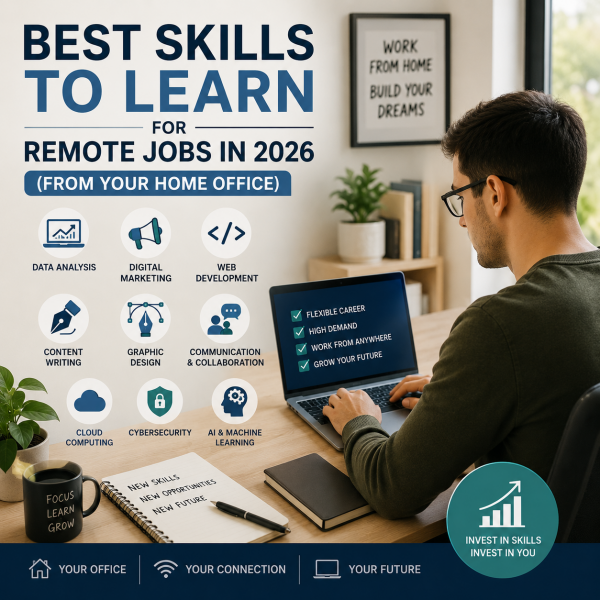
Introduction
Remote work isn’t just a trend anymore — it’s the default for millions of professionals worldwide. But as remote jobs multiply, so does the competition. If you’re dreaming of ditching the commute (or keeping it ditched), you’ll need more than a reliable Wi-Fi connection and a tidy home office setup. The skills that employers want in 2026 are sharper, more tech-forward, and more human than ever. Whether you’re job hunting, upskilling, or future-proofing your career, this guide walks you through the best skills to prioritize for remote jobs — and exactly how to start building them today.
How We Selected
We didn’t pull these picks out of thin air. Our selections are grounded in real employer demand, expert career research, and the day-to-day realities of distributed teams. We pulled insights from remote work hiring platforms, AI education resources, and workforce development research [1][2][3][4]. Every skill on this list is highly transferable across industries, learnable online at any experience level, and genuinely valued by remote-first employers in 2026. We also gave extra weight to skills that complement async work culture and sharpen your overall online productivity.
Top Picks Table
| Rank | Skill | Why It Matters for Remote Work |
|---|---|---|
| #1 | AI Literacy & Prompting | Automates tasks, boosts output |
| #2 | Analytical & Critical Thinking | Solves problems independently |
| #3 | Async Communication | Keeps distributed teams aligned |
#1 AI Literacy & Prompting
If there’s one skill that has rocketed to the top of every remote job wish list, it’s AI literacy. Employers in 2026 don’t just want people who use AI tools — they want people who know how to work with them strategically [2]. That means writing effective prompts, automating repetitive workflows, and leveraging AI-powered tools for research, writing, coding, and data analysis. The good news? You don’t need a computer science degree. With focused online learning, you can go from AI-curious to AI-confident in just a few weeks. Structured courses covering everything from prompt engineering to productivity automation are a great place to start.
#2 Analytical & Critical Thinking
Remote work means solving problems without someone looking over your shoulder — and that’s exactly where analytical and critical thinking become your secret weapons. Employers consistently rank these cognitive skills among the most valued competencies for distributed teams [1]. Strong analytical thinking helps you break down complex challenges, evaluate information objectively, and make confident decisions on your own. Best of all, these are learnable, trainable skills — not just innate talents. University-level programs offer a solid foundation in structured reasoning and evidence-based thinking that transfers directly to any remote role.
#3 Async Communication & Digital Collaboration
In a remote-first world, how you communicate in writing matters just as much as what you say. Async communication — sharing updates, feedback, and ideas without requiring everyone to be online simultaneously — is the heartbeat of distributed teams [3]. Knowing your way around Slack, Notion, Loom, and project management platforms is table stakes. But the real skill is writing clearly, setting context, and moving projects forward without endless meetings. Layer in strong time management and self-discipline, and you’ll stand out immediately [4]. Creative and professional skills platforms are a fantastic place to practice real-world async communication through hands-on projects.
→ Browse courses on Skillshare
Buying Guide
How to Choose the Right Skills to Focus On
Not sure where to start? Here’s a simple framework:
- Match skills to your target role. A remote customer success manager needs different tools than a remote data analyst. Scan 10 job postings in your field and note the skills that keep showing up.
- Prioritize high-income, high-demand combos. Skills like analytical thinking, AI proficiency, and leadership overlap across remote roles and consistently command higher salaries [4].
- Choose stackable learning. Pick courses that build on each other — start with async communication basics, layer in project management, then add AI productivity tools.
- Get certified where it counts. LinkedIn certificates and university-backed credentials give your remote job applications extra credibility, especially when hiring managers can’t meet you face to face.
For professional development with LinkedIn certificate integration, this platform is well worth bookmarking.
→ Browse courses on LinkedIn Learning
FAQ
Do I need tech skills to get a remote job in 2026?
Not necessarily! Digital literacy helps, but many remote jobs — in writing, customer support, education, and project management — don’t require deep technical expertise. That said, familiarity with collaboration tools and basic AI applications will always give you an edge [3].
How long does it take to learn these skills?
Most foundational skills take 4–12 weeks to build with consistent daily practice. Micro-credentials and short courses from universities and online platforms make this more accessible than ever [2].
Are free courses good enough, or should I pay for certifications?
Free courses are a great starting point, but paid certifications — especially from recognized institutions — can boost your credibility with remote employers. Short courses and degrees from leading universities strike a solid balance between affordability and recognition.
→ Browse courses on FutureLearn
What’s the single most important skill for remote work success?
If we had to pick one: self-discipline combined with clear communication. Tools and technology can always be learned — but the ability to manage your time, communicate proactively, and stay accountable without direct supervision is what truly separates thriving remote workers from struggling ones [3][1].
Interested in this topic?
Online Learning vs Traditional Education: Which Is Better for Remote Work and Career Growth?
Best Remote Jobs in 2026: Top Work-From-Home Careers and Tools
Highest Paying Remote Jobs in 2026: Complete Work-From-Home Salary Guide